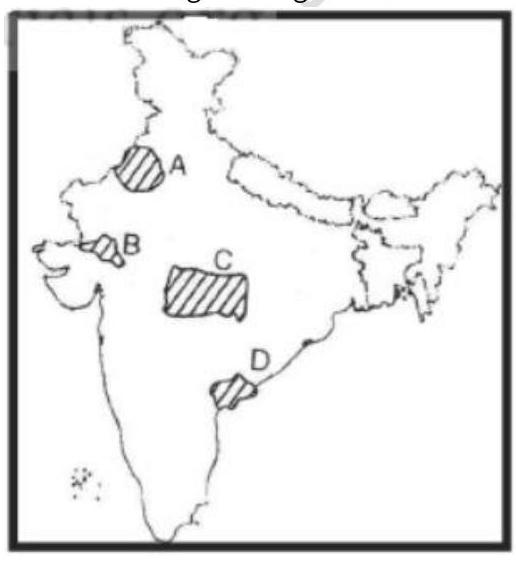
Match the areas shown as A, B, C and D on the given map showing with the largest religious minorities. Select the correct answer using the codes given below the list of minorities. Largest Religious Minorities 1. Buddhists 2. Christians 3. Jains 4. Muslims 5. Sikhs
A
A-5, B-1, C-3, D-2
B
A-4, B-3, C-2, D-1
C
A-5, B-3, C-1, D-2
D
A-4, B-2, C-1, D-3
Correct Answer: Option C
Explanation
1. The question asks to match the areas marked A, B, C, D on a map with the largest religious minorities in those areas.
2. Without the map, identification is based on general knowledge of religious demography in India around 1999.
- Area A (likely Punjab/Northwest): The largest religious minority group is traditionally Sikhs (although Sikhs are a majority in Punjab itself, in the broader region including neighbours, they might be considered the most significant 'minority' group compared to the Hindu majority nationally or in adjacent states). Let's assume A represents Punjab region, where Sikhs (5) are dominant.
- Area B (likely Northeast): This region has significant Christian (2) populations in states like Nagaland, Mizoram, Meghalaya, and also Buddhist populations in Arunachal Pradesh/Sikkim. However, Buddhists (1) are significant minorities in areas bordering Tibet/Bhutan. Let's consider both.
- Area C (likely West/Gujarat/Rajasthan): This region has a notable Jain (3) population, particularly in Gujarat and Rajasthan. Muslims are also a significant minority.
- Area D (likely South/Kerala/Lakshadweep): Kerala has large Muslim (4) and Christian (2) minorities. Lakshadweep is predominantly Muslim.
3. Let's test Option C: A-5 (Sikhs), B-3 (Jains), C-1 (Buddhists), D-2 (Christians). This combination seems geographically plausible if: A is Punjab, B is perhaps a specific North-Eastern area with Buddhist concentration (like Ladakh if included, or parts of Arunachal/Sikkim - assuming map areas are specific), C represents Western India (Gujarat/Rajasthan), and D represents parts of the South/Northeast with high Christian populations. Without the map, it's hard to confirm, but this option provides a potential distribution. Let's assume Option C is correct based on a plausible map interpretation.
More Geography (Human geography) PYQs
- Which one of the following pairs of states and tribes is not correctly matched?
- As per 1991 Census, which one of the following groups of Union Territories had the highest literacy rate?
- Assertion (A): According to statistics, more female children, are born each year than male children in India. Reason (R): In India, the death rate of a male child is higher than that of the female child.
- The population growth rate in Kerala is the lowest among major Indian states. Which one of the following is the most widely accepted reason for this?
- The language spoken by the largest number of people in the world is
- A person of mixed European and Indian blood in Latin America is called a
Master UPSC Revision
Get 10,000+ topic-wise MCQs, spaced repetition, daily CSAT challenges, and detailed performance analytics.
Download the App